
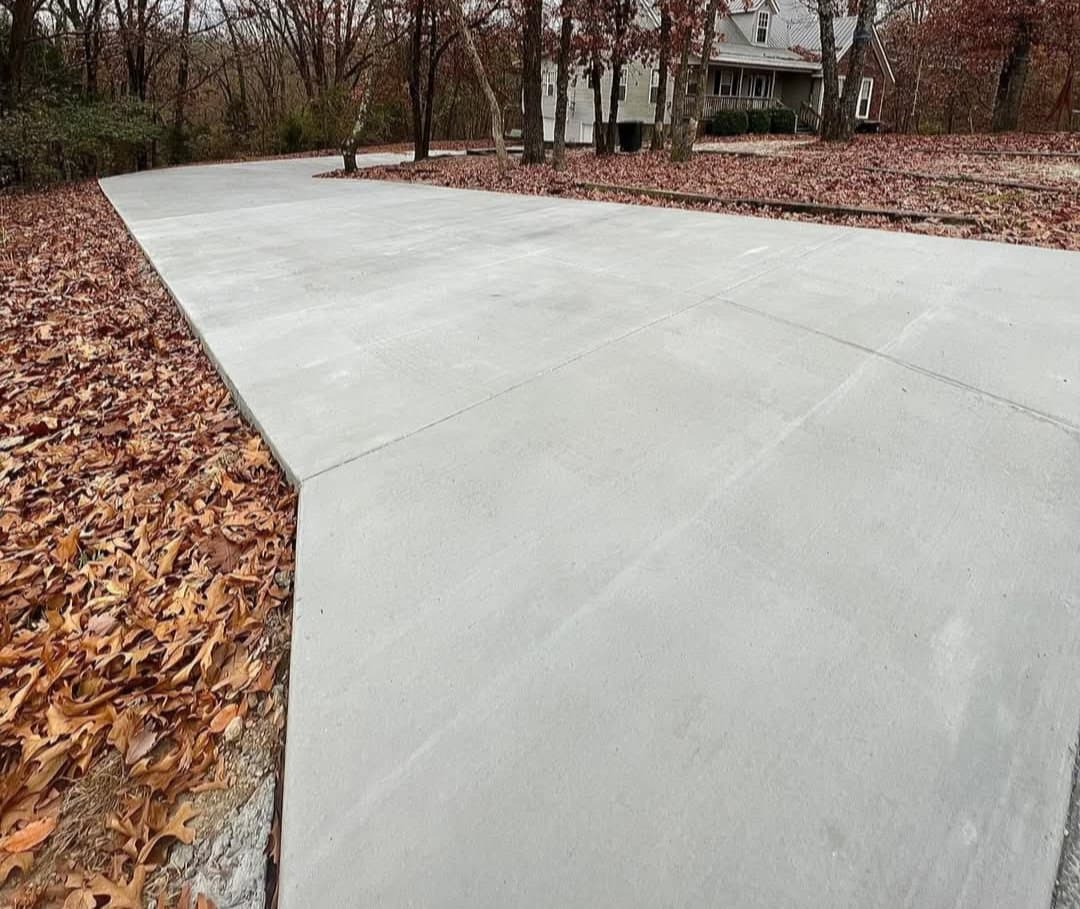
Concrete driveways built on a base that lasts
Full tear-out and replacement or a new pour, at the thickness and reinforcement your vehicles actually need.
Why most driveways fail - and how we stop it
A driveway that cracks in its second winter almost never failed because of the concrete. It failed because the subgrade was not compacted, the slab was poured thin, or the control joints were cut in the wrong places. We fix all three before the truck ever shows up.
Standard residential pours go 4 inches on a compacted base; anything carrying a truck, RV or trailer gets 5 to 6 inches with rebar on chairs. We grade to move water away from the garage and the foundation, not toward it.
What's included
- ✓Demo and haul-off of the existing driveway
- ✓Excavation and compacted aggregate base
- ✓Rebar or fiber-mesh reinforcement sized to the load
- ✓Saw-cut control joints on a proper spacing grid
- ✓Broom, smooth or exposed finish of your choice
- ✓Grading that drains away from the house
Concrete Driveways - common questions
How thick should a concrete driveway be in Arkansas?
4 inches is the minimum for passenger vehicles; we recommend 5 inches for heavier trucks or RVs. The base underneath matters as much as the slab thickness. We go 4–6 inches of compacted gravel.
How long before I can drive on a new concrete driveway?
7 days for passenger vehicles, 28 days for full strength. You can walk on it in 24 hours. We'll mark it off and tell you exactly when it's ready.
Do you replace just the apron, or the whole driveway?
Either. If the rest of the slab is sound and only the apron is spalling, we can demo and pour just that section. If the whole driveway is failing, a full replacement is usually the better value.
Concrete Driveways near you
We pour concrete driveways across Benton and Washington County. Pick your city for local details.
Ready for a free on-site estimate?
Covering all of Northwest Arkansas. Call, text, or send us the details and we'll come measure it.